Aloys Wenzl was a professor of philosophy at Ludwig Maximilian University in Munich and a friend and colleague of Hedwig Conrad-Martius, and the two of them were in a reading group together on the philosophy and science of space and time. I include his work on my website because Wenzl shares with Conrad-Martius the Neoaristotelian world-view based on trans-physical entelechies, some of which actualize in the fourth space-time dimension, and some in other space-time dimensions. Conrad-Martius’ entelechial world-picture and theory of the fourth dimension as an aeonic space-time (eternity) was also influential on the later Munich theoretical physicist Burkhard Heim. Conrad-Martius’ first-philosophical contribution of foundations to theoretical physics are also mentioned by such notable thinkers as Marie-Louise von Franz in Number and Time: Reflections Leading toward a Unification of Depth Psychology and Physics, and Jean Gebser in The Invisible Origin.
Unsterblichkeit: Ihre Metaphysische und Anthropologische Bedeutung
Unsterblichkeit: Ihre Metaphysische und Anthropologische Bedeutung. Munich: Leo Lehnen Verlag (1951). Front material.
File: Front matter of Unsterblichkeit
Image: A comparison of Conrad-Martius’ diagram of aeonic space-time and Wenzl’s diagram of the fourth space-time dimension. Wenzl builds up to this image over the pages of the next excerpt.
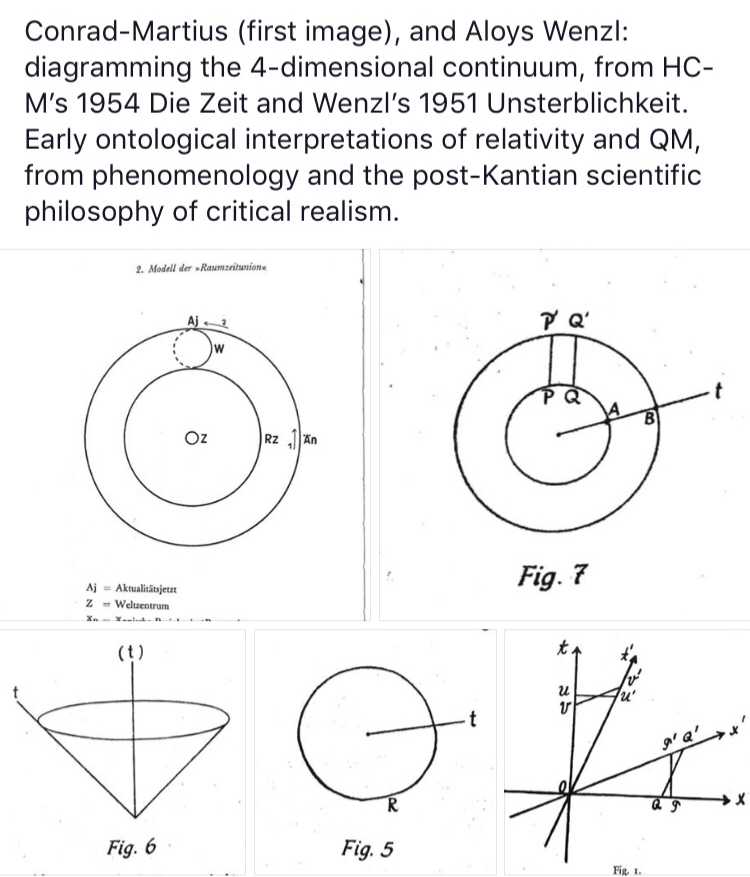
The upper-left image is from Hedwig Conrad-Martius’ 1954 book Die Zeit, and the rest are from the selection from Wenzl’s 1951 book Unsterblichkeit pages 29-50 (below).
Unsterblichkeit: Ihre Metaphysische und Anthropologische Bedeutung (excerpt: 29-50)
Unsterblichkeit (excerpt: 178-185)
Unsterblichkeit: Ihre Metaphysische und Anthropologische Bedeutung. Summary in 10 theses, and the concept of “Space-time gestalt” (178-185).
Unsterblichkeit (excerpt: 109-116)
Unsterblichkeit: Ihre Metaphysische und Anthropologische Bedeutung. “Schlussbetrachtungen zum Theoretischen Teil: Stofflichkeit und Wirklichkeit der Welt,” 109-116:
File: Unsterblichkeit (109-116)
 randolphdible.com